“Happy ending” culture
From “harmless” jokes to inappropriate client behaviour, Ellen Cummings speaks to massage therapists about how stigma continues to shape their practice and what needs to change
A client laughs and asks, “That doesn’t come with a happy ending, does it?” For some people, it may feel like a throwaway joke. But for many massage therapists, it is a comment loaded with fear and frustration – one that reinforces outdated stereotypes about a profession built on care and trust.
Across the beauty and wellness industries, therapists say these comments still happen, whether during consultations, through online enquiries or while carrying out treatments – and even coming from the general public.
While experiences vary, many describe a shared reality: constantly having to defend the legitimacy of massage therapy against sexualised assumptions.
Workplace harassment in the UK
While there is limited industry-specific data on inappropriate behaviour towards massage therapists, wider UK workplace research shows sexual harassment and workplace abuse remain a significant issue for women across multiple sectors – something that is particularly relevant in a predominantly female industry built around one-to-one client interactions
According to the Chartered Institute of Personnel and Development (CIPD), 25% of UK employees experienced workplace conflict or abuse in 2024, while previous CIPD research found 4% of workers had experienced sexual harassment at work.
Research from University College London also found women were nearly twice as likely as men to experience workplace abuse.
For therapists working in close-contact environments – often alone, behind closed treatment room doors or in clients’ homes – many say the emotional impact of inappropriate comments or behaviour can feel especially personal.
A persistent stereotype
For Rachel Stevens, a professional skin therapist, educator and finalist for Mobile/Home-based Beauty Business of the Year at the Professional Beauty Awards 2026, the issue reflects a wider misunderstanding of the profession.
“There’s a strange cultural hangover where people feel it’s acceptable to make jokes about sexual harassment in relation to massage,” she says. “Every ‘happy ending’ joke chips away at the credibility of an industry built on anatomy, physiology, client care and ethics. It reinforces the stereotype that this isn’t a serious profession.”
That frustration is echoed by multi-award-winning massage therapist Hayley Snishko, founder of Home Sanctuary, Mind Body Touch Training and the Massage4MentalHealth campaign.
“Massage can genuinely support pain relief, stress management and mental health, but those benefits often get overshadowed by this stereotype,” she explains. “Through my
Massage4MentalHealth campaign work especially, I’ve seen how powerful therapeutic touch can be for people struggling with their mental health, so it’s frustrating when the profession is reduced to something sexualised or treated like a joke.”
Lived experiences
While some therapists say they only encounter inappropriate behaviour rarely, many describe experiences that have stayed with them for years.
Michaela Morris, a skin and waxing specialist and owner of Bare All Skin in Cornwall, recalls a very unsettling experience while working as a mobile beauty therapist in Switzerland early in her career. A client repeatedly implied he wanted sexual services during a massage treatment, eventually exposing himself and pressuring her to continue.
“My feelings were, ‘Am I safe?’ ‘What happens if he attacks me?’ ‘What happens if he forces me to do something?’” she says. “As I’m telling you this now, over a decade later, my hands are shaking.”
Morris says the experience still affects how she works today, and is part of the reason she stopped providing massage services altogether. “When I started working solo in my cabin in my garden, I was very conscious of being on my own. I just didn’t want men in my space,” she explains.
“It’s a shame because before I started in this career, I had loads of male friends and it was never an issue. I sound like a man hater but I'm not – it's just that those few bad experiences with male clients have definitely shaped how I view men.”
Stevens also remembers incidents from early in her career where inappropriate behaviour was minimised rather than addressed. “One colleague was prevented from leaving a treatment room by a client twice her size after he removed his underwear and made her feel unsafe,” she says. “When she reported it, she was told by management that it was ‘just one of those things’.”
Looking back, Stevens says that the industry too often normalised unsafe situations for therapists. “We can’t normalise risk as ‘part of the job’,” she adds.
The wider impact
Therapists say the problem is not just individual incidents – it is the wider cultural stigma surrounding massage therapy.
“I think it persists because of decades of representation in modern culture, television and film,” says Stevens. “Massage has been used as shorthand for innuendo so often that the stereotype became embedded in public consciousness.”
“Every ‘happy ending’ joke chips away at the credibility of an industry built on anatomy,
physiology
, client care and ethics. It reinforces the stereotype that this isn’t a serious profession”
Snishko agrees that media and online culture continue to blur public understanding of legitimate massage therapy. “I think part of the issue is that there are businesses offering sexual services under the disguise of massage, which then blurs public understanding of legitimate massage therapy,” she says.
“This combined with media portrayals, online culture and years of massage being used as a joke or innuendo, the stereotype has become deeply ingrained.”
The result, therapists say, is that professionals are often forced to constantly re-establish boundaries and legitimacy. “What people often don’t realise is that this stereotype can make therapists feel unsafe in their workplace, and put them in unwanted situations,” says Snishko. “No one should feel unsafe simply for doing their job.”
Working alone safely
For mobile, home-based and solo therapists in particular, safety concerns can shape entire business models.
“Working from home means I’m intentional about safety,” says Stevens. “I only see male clients who are referred by trusted existing clients. I don’t take appointments from unknown men.”
Snishko has implemented similar processes. “There are a few processes I have in place to work safer,” she explains. “Referralonly clients. I always talk to the client on the phone before the first appointment. My husband always knows where I’m working, I have a ‘leave quick’ plan in place and I always keep my phone within reach.”
The therapists interviewed for this feature said they now:
• Operate referral-only policies
• Avoid accepting unknown male clients
• Keep phones nearby during treatments
• Inform family or colleagues where they are working
• End treatments immediately if boundaries are crossed
But therapists argue they should not have to learn these measures through experience alone.
The training gap
All three therapists said they received little or no training on handling inappropriate client behaviour at the start of their careers. “Absolutely not,” says Snishko. “I don’t remember receiving any proper training around inappropriate behaviour, boundary setting, de-escalation, or what to do if a client made me feel unsafe.”
Stevens believes safeguarding and boundary education should be standard within beauty therapy and massage training. “You’re in an incredibly vulnerable position alone in a room, with a client undressed, responsible for maintaining professionalism,” she says. “New therapists deserve preparation for that reality from day one.”
Morris believes more therapists may be carrying experiences they do not openly discuss. “I don’t know whether it’s something that we’re meant to talk about, or if it’s something we feel shame from and don’t talk about because it’s embarrassing or triggering,” she says. “It probably really does need to be spoken about more widely.”
Industry responsibility
Therapists say meaningful change requires support at every level of the industry. “Support starts with culture,” says Stevens. “Therapists must know management will back them 100% if they end a treatment.” She believes salons and spas need:
• Clear reporting procedures
• Zero-tolerance policies
• Lone-worker safeguarding measures
• Better staff training on boundaries and consent
Snishko agrees that therapist safety must be prioritised over customer retention.
“Therapists should know that management will fully support them if they decide to stop a treatment or refuse a client,” she says. “Without that support boundaries can easily be crossed, and therapists can end up feeling pressured into situations they shouldn’t have to tolerate.”
The therapists also believe change needs to begin earlier – including within schools and education settings.
Useful UK support resources for women experiencing harassment
England and Wales:
• Rape Crisis England & Wales – Support for sexual harassment and violence, including helpline and counselling.
• Victim Support – Free emotional and practical help for victims of crime, including workplace abuse.
• Women’s Aid – Support for women experiencing domestic and sexual abuse.
Scotland:
• Rape Crisis Scotland – Confidential support and counselling for survivors of sexual violence.
• Scottish Women’s Aid – Support for women affected by domestic and sexual abuse.
• Scottish Women’s Rights Centre – Free legal advice and advocacy for gender-based violence.
Northern Ireland
• Nexus NI – Specialist counselling for survivors of sexual abuse and violence.
• Women’s Aid NI – Support, refuge and advice for domestic and sexual abuse.
• Victim Support NI – Emotional and practical support for victims of crime.
UK-wide
• Suzy Lamplugh Trust – personal safety guidance and workplace safety resources.
• Acas sexual harassment guidance – advice on workplace sexual harassment rights and employer responsibilities (in Northern Ireland, employment relations services are mainly handled by the Labour Relations Agency).
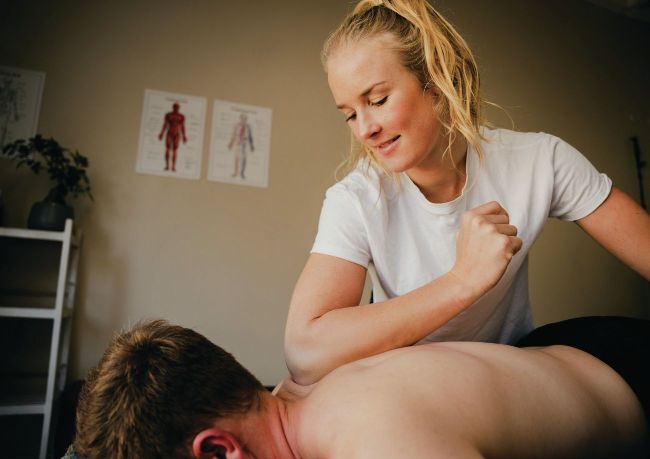
“Beauty and wellness are frequently treated as a fallback if academic options don’t work out, rather than a first-choice career requiring anatomy, physiology, client care and business acumen,” says Stevens. “If we want public perception to change, it has to start in schools.”
Changing perceptions
For many therapists, the issue ultimately comes down to respect – both for the profession itself and for the people working within it.
“It’s a legitimate profession,” says Stevens. “We study the same body systems as other manual therapists, we’re insured, we follow clinical guidelines and we’re accountable to professional bodies.”
She adds, “You wouldn’t make those jokes about a physiotherapist or osteopath, so why is massage different?”
Snishko believes the industry must stop accepting inappropriate behaviour as inevitable. “One of the saddest parts of this issue is how normalised it’s become within the industry itself,” she says. “So many therapists have safety routines, booking rules, exit plans or stories about inappropriate behaviour, and it’s often spoken about like it’s just ‘part of the job’. It shouldn’t be.”
And for Stevens, changing the conversation around consent and boundaries is about something bigger than the treatment room. “The real happy ending,” she says, “is a culture where everyone’s ‘no’ is heard the first time.”