Lashes
We have lift off
If your clients are looking for long, lifted lashes – but don’t want to compromise on the health or integrity of the hair – then the Korean lash lift could be exactly what you're looking for, writes Josie Jackson
Much like makeup and nails, lashes are subject to trends – both in terms of styles and techniques. Of course, not every client will be after a “trending” lash look, but for those who are, you’re going to want to turn your attention to the Korean lash lift.
Prioritising lash health
With K-beauty trends currently dominating, it’s no surprise that the next big lash technique hails from Korea, too. Specifically, the Korean lash lift was created in South Korea and is regarded by many as a more advanced technique, thanks to the use of cysteamine instead of thioglycolic acid (TGA). Discussing why this matters, Rose Lonsdale, global senior education manager for Nouveau HD Beauty Group, explains, “While both ingredients break down disulphide bonds, cysteamine does this slower, giving lash artists more time to work.” While this can add an extra 15 minutes to treatment times, the risk of overprocessing is reduced, which is why some lash techs and clients favour this method.
However, it’s worth noting that cysteamine itself is not a hydrating ingredient. Nancy Miles, a Hove-based lash and brow technician, explains, “When you combine it with additional ingredients like keratin, peptides and hyaluronic acid, it works to lift and set the lashes into the perfect curl while keeping the natural hairs hydrated, healthy and glossy.”
Cysteamine has a lower pH than TGA, which means it can be applied more effectively. “Traditional lash lifts usually use TGA-based solutions, which are too harsh to apply to the tips,” says Laura Victory, a Hampshire-based lash lift educator. “However, with cysteamine-based products you can apply them to the full lash length, including the tips, resulting in more even, longer-lasting results.”
Time for change
It’s not just the ingredients that set a Korean lash lift apart; it often uses a two-shield system. “Lashes are first pre-lifted from the root using a specially developed flat shield, and then shaped and curled with a glueless shield,” explains Beverly Piper, lash specialist and founder of The Eyelash Design Company. By avoiding the use of an additional adhesive, this approach can provide reduced irritation for those with sensitive eyes, adding to its popularity.
Georgie Muscio, co-founder of Buff Browz, believes that the Korean lash lift has influenced the entire approach to lash lifts. “The priority is lash health first,” she says. “Korean lash artists emphasise technique, lash assessment, gentle processing and nourishing aftercare, resulting in stronger, shinier lashes over time.” It’s no surprise that lash techs from all over the world have started to follow their lead.
Despite a different process, aftercare for a Korean lash lift is similar to that of traditional lash lifts, making it simple for professionals looking to offer this service to their clients. “I direct my clients to keep them dry for the first 24 hours, and to avoid mascara, steam and saunas,” says Lauren Hamer, a Korean lash lift educator and business coach from Newcastle. “After that, I recommend they brush them daily and use a lash serum if they want to keep them strong. Compared to extensions, it’s basically maintenance-free.”
While a low-maintenance treatment is a big draw for many clients, longevity is another priority. Victory explains that results can last up to eight weeks, though individual lash growth cycles and good aftercare also play a part. For clients enquiring about a Korean lash lift, she tells them, “The results stay looking lifted for longer, much like a gel polish that lasts better when applied closer to the cuticle.”
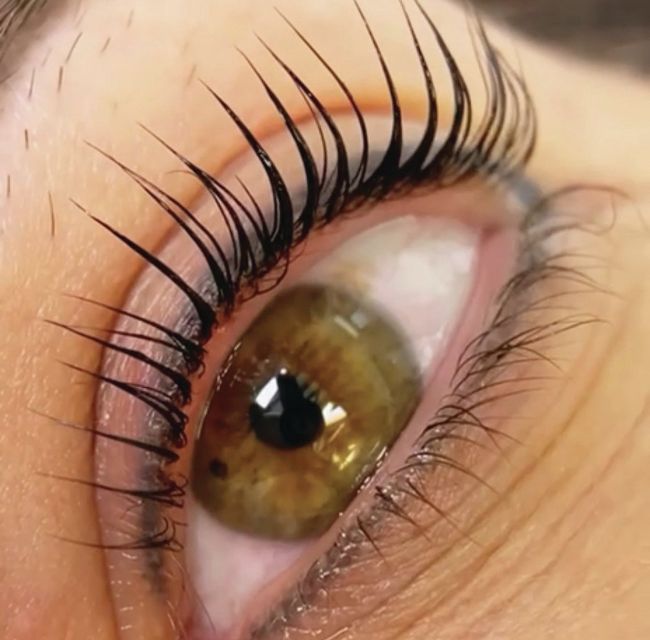
Laura Victory
Finding your audience
With Korean lash lifts currently trending online, it’s easy to assume this treatment will sell itself, but you don’t want to risk complacency. “Due to social media, clients have heard of the technique but don’t necessarily know what it is,” notes Lonsdale.
That’s why clear messaging is crucial if you’re looking to convert queries to bookings; you want to ensure that anyone that looks at your treatment list knows exactly what it is you’re offering. Sharing how she describes a Korean lash lift to potential clients, Hamer says, “It’s as though your normal lash lift has had a glow-up, giving that clean, glossy, super-lifted lash look without the dryness or damage that sometimes comes with a ‘standard’ lash lift.”
It's also a good idea to consider which clients this treatment would be a good fit for – and the great thing about Korean lash lifts is that it’s almost everyone, according to Paige McCarthy, training manager for Pink Fishes. However, if you’re looking to focus your marketing efforts more precisely, she adds, “It’s particularly great for someone that has stubborn, downturned lashes, and is also great for someone that has really curly natural lashes, as the entire lash is treated and can be reconfigured into a new shape, rather than just the base.”
Another selling point of the Korean lash lift is its potential to provide personalised results. “Our glueless shields are available in a range of sizes, giving professionals the ability to customise the treatment based on the level of lift required,” notes Piper. “For example, if a client wants a more dramatic look, you can select a smaller shield.”
However, there are still some clients that might not be a good fit for a Korean lash lift. “The only lashes I’d be cautious with are those that are extremely brittle or over processed from a previous lift – those will need a little TLC first,” shares Miles.
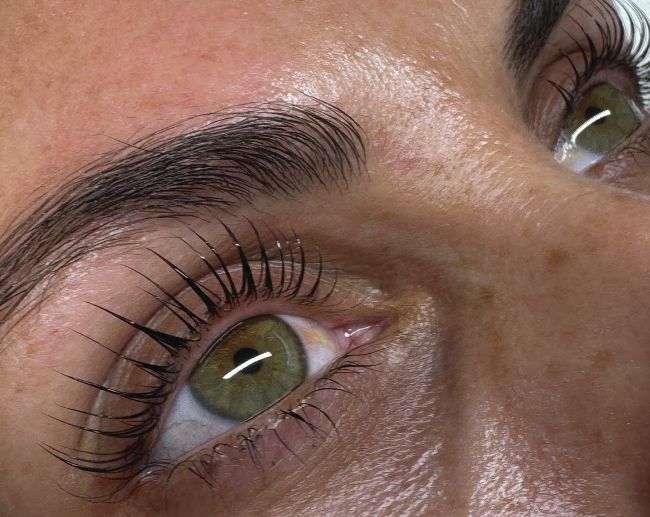
Nancy Miles
“Korean lash lifts have offered more choice to our treatment menus, allowing us to cater for every client who walks through the door”
Perfect your skills
With any new technique, education is crucial, and as this trend is already showing signs of dominance, Muscio notes that Korean lash lifts are likely to become an essential skill for modern lash professionals. However, because this technique relies on a more advanced formulation and application method, the need for comprehensive training has never been clearer. “You can’t just buy the products and wing it,” stresses Hamer. “Timings, shields and processing are completely different to a traditional lash lift; you need to understand lash structure, pH and how to adapt for each client.”
Ensuring you’re adequately trained not only protects the integrity of your clients’ lashes, but also safeguards your reputation as a professional offering a specialist service. When looking into options to train in a new treatment, Lonsdale suggests investing in more than one course to find your favourite way of performing the technique as there are different variations, alongside a huge range of products hitting the market. “From there, practise the technique and take note of which clients benefit from it and which are more suited to a traditional lift, she advises. “It is not a one-technique-fits-all approach.”
Providing clients with choice
Introducing Korean lash lifts into your service menu doesn’t mean you have to stop offering traditional lash lifts – it’s all about giving your clients options. “Korean lash lifts have offered more choice to our treatment menus, allowing us to cater for every client who walks through the door. It has not taken over the traditional lash lift, simply complemented it,” shares Lonsdale.
Likewise, McCarthy notes, “If technicians can determine which methods will suit their client’s lashes the best, then both will have a place in the industry for a very long time.” This ability to tailor results is especially relevant given the type of look clients are currently gravitating towards.
The Korean lash lift encapsulates the “clean girl” aesthetic that has been dominating the beauty landscape ever since the pandemic, which favours minimal yet luxe finishes that emphasise a less-is-more approach. For professionals, this rise in “quiet luxury” presents a valuable opportunity – clients are willing to invest in treatments that promise refinement rather than excess, especially those that maintain the integrity of their natural lashes.
Reflecting on the changes to techniques and product innovations, Miles shares that how she thinks about lash lifting has completely changed. “I now focus on long-term lash health in every service I offer. The Korean approach – gentle, results-driven and detail-oriented – has filtered into everything I do, from client consultations to aftercare advice.”
Ultimately, the Korean lash lift offers artists another tool in their kit – one that aligns with modern beauty ideals while prioritising lash health. For professionals wanting to futureproof their treatment menus, it’s a trend with real staying power.