Interview
TALKING TO… Fiona Jackson
Newly qualified therapists are entering the workplace with technical skills but limited real-world experience. Fiona Jackson tells Eve Oxberry how her new RISE programme is working to address this gap
As the beauty industry continues to grapple with recruitment challenges, a growing number of employers are questioning whether the issue is really a shortage of talent. For salon owner and educator Fiona Jackson, the problem runs deeper – newly qualified therapists are entering industry without the confidence and real-world understanding needed to succeed.
“I don’t think it’s a shortage of talent,” she says. “It’s a readiness gap. Therapists just aren’t ready to step from education into industry.”
Jackson, who owns beauty salon Diva in Lanarkshire and runs training and mentorship business Salonwise, saw this first-hand when she returned to hiring after several years without needing to recruit. “It was a horrific experience,” she says. While students are leaving college with qualifications, she believes many are missing the softer skills needed in a working environment. “They’ve got the certificate, they’ve passed everything, and they think, ‘right, I’m a beauty therapist’. But the sad thing is they don’t actually know what they’re missing.”
At the same time, she is clear that responsibility does not sit solely with education. “Colleges do a great job, but it’s very treatment-based and there just isn’t the time anymore,” she explains. “And industry doesn’t support new therapists particularly well either. Students struggle to get work experience, and even when they do, they’re not always getting the right exposure.”
There is also a commercial reality behind the issue. Taking on newly qualified therapists is a significant investment for salons, particularly when they are not yet working at full speed or confidence. “It’s not getting any cheaper for people to take on staff,” Jackson says. When new hires are slower, unsure with retail or lacking confidence in client interaction, it can make the decision to recruit at entry level feel risky.
“It’s expensive for businesses to take on new staff, especially when they’re not fully ready. If we can support therapists better at the start, it benefits everyone”
The launch of RISE
It was this combination of experiences that led to the development of RISE, which stands for Ready for Industry, Success & Excellence, a programme designed to support students in the final stages of their training and help them transition into employment with more confidence and awareness.
The idea had been forming for some time, but it was entering Professional Beauty’s Pitch for the Future competition that pushed Jackson to take action. “It was just an idea on paper before that,” she says. “The competition gave me the kick I needed to actually do something with it.”
Working through the pitch and developing the concept highlighted the scale of the issue. “The more people I spoke to about it, the more I realised how big a problem it actually is. There are very few people I’ve met who don’t see it as a gap,” she adds.
After pitching her idea live at Professional Beauty London 2025 to a panel of judges – all of whom run their own businesses – Jackson was named runner-up, narrowly missing out on the win (which went to Sarah Michelle
Durrant’s Serene on Scene concept) and leaving with a prize of £1,000 to invest in her launch. The money played a practical role in helping her move forward. A portion was used to complete an assessor qualification, while the rest went towards branding and materials for the launch, including reusable pop-up banners. “It just helped me get everything in place to actually deliver it,” she says.
What RISE offers
RISE is structured as a two-day, in-person programme delivered towards the end of a student’s course, with a gap between sessions. The timing is aimed at reaching students just as they begin to make decisions about their next steps. “It’s designed to be done in the last six months of their course,” Jackson explains. “It’s helping them decide what route suits them and giving them confidence to go to interviews and trade tests knowing what to expect.” She says a lot of students come out of college thinking they will just be judged on the treatments, whereas “actually it’s everything – first contact, consultation, the treatment, aftercare, retail, building that relationship.”
Confidence beyond treatment skills
Communication is a central theme throughout the programme and Jackson has observed a shift in how younger therapists interact with clients; something she feels has been influenced by digital forms of communication.
“A lot of people coming into the industry now aren’t used to having those face-to-face conversations,” she says. “They struggle to read body language and create that safe space that clients are looking for.”
Drawing on her own experience, she introduces students to the realities of working with clients in a way that is rarely covered in formal training. “We’re called beauty therapists, but we’re not trained as therapists,” she says. “And yet people come to us with everything. The highs, the lows, grief, happiness. That’s all in a treatment.”
By sharing real scenarios from her career, she aims to give students a clearer sense of what the role involves and how they might respond. “I’ve had clients break down in tears, I’ve had them tell me about a family member who is dying. You’re not going to get that every day but new therapists need to have an idea of what they might be faced with and think about how they’d react,” she adds. “Sometimes it’s just about listening. Sometimes it’s holding someone’s hand but it’s important to feel prepared.”
The programme will initially be delivered in partnership with colleges, with Jackson working directly with course leaders to identify students in the final stages of their training. Rather than fixed public dates, sessions are arranged around each college’s timetable, with delivery kept in person. “I deliberately haven’t done any online training with RISE because it’s all about communication and doing things face to face,” she says.
Students complete two full training days with a gap in between, alongside coursework and continued support. While the programme is currently focused on college delivery, there are plans to expand into external training spaces and additional sectors. “We’re working on an individual basis at the moment,” she says, with conversations underway to adapt the content for areas such as hairdressing. Alongside the core training, students will be added to a peer network, including a
WhatsApp group, to maintain connection.
“I just want them to feel as if they have a little bit of additional support, so they don’t feel as if they’re just being trained then left to it,” Jackson adds. The intention is to create not just a short course, but a supported transition into the industry, with ongoing access to guidance as students move into work.
Early industry support
Since its official launch event in Glasgow in February this year, RISE has already begun to attract interest from across the industry. “I’ve got colleges trying to organise funding, which is great but it’s a slow process,” she says. “And I’ve had product brands like Wella looking at funding places for students as well.”
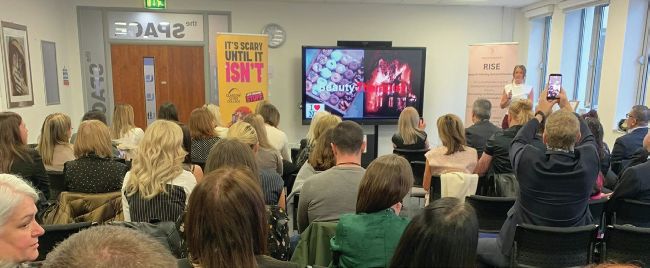
JACKSON HOSTING THE LAUNCH OF RISE IN GLASGOW IN FEBRUARY
At the same time, demand is not limited to new graduates. “Some spas are saying they need help with their current staff,” she adds. “They’re seeing the same issues around confidence and communication.”
The programme is currently priced at an introductory offer of £295 per student for the first intake to encourage uptake. Even so, Jackson acknowledges that relying on individuals to fund their own development is a challenge. “Ultimately, I would love to see funding in place,” she says. “Because this isn’t just about the individual. It’s about the whole industry.”
That wider perspective has also led her into conversations around apprenticeships and government support. With no formal apprenticeship scheme in Scotland, she believes there is a gap in how new therapists are supported once they leave education.
“Back in October, I had a meeting with my local MP. I've since had another meeting with another MP and the Minister of Business and Trade. They've asked to see the RISE programme, and this is all based on the fact we need some sort of apprenticeship scheme in Scotland,” she explains. “It’s expensive and time-consuming for businesses to take on new staff, especially when they’re not fully ready. If we can support therapists better at the start, it benefits everyone.”
Future focus
Looking ahead, Jackson’s ambitions for RISE are focused on recognition and integration. She would like to see it become something employers actively look for when hiring.
“I want employers to see RISE on a CV and know that this is someone who’s invested in themselves and is serious about their career,” she says. “And ideally, I’d love it to be part of education in some way.”
At its core, the programme is about supporting the next generation entering the industry and giving them a stronger starting point. For Jackson, that is where long-term change begins. “It’s a phenomenal industry to work in,” she says. “These therapists are the future of it, and we need to give them the best possible start.”
Key dates
2001
Fiona Jackson works as a spa therapist and Elemis’s onboard educator on Steiner cruise ships
2003
Opens her own salon, Diva in Lanark
2005
Begins lecturing part-time in both private and public colleges across Scotland
2022
Launches Salonwise as a training academy, evolving it into a mentorship business
2025
Pitches the concept of RISE live to judges as part of Professional Beauty’s Pitch for the Future competition
2026
Officially launches RISE to help bridge the gap between industry and education